
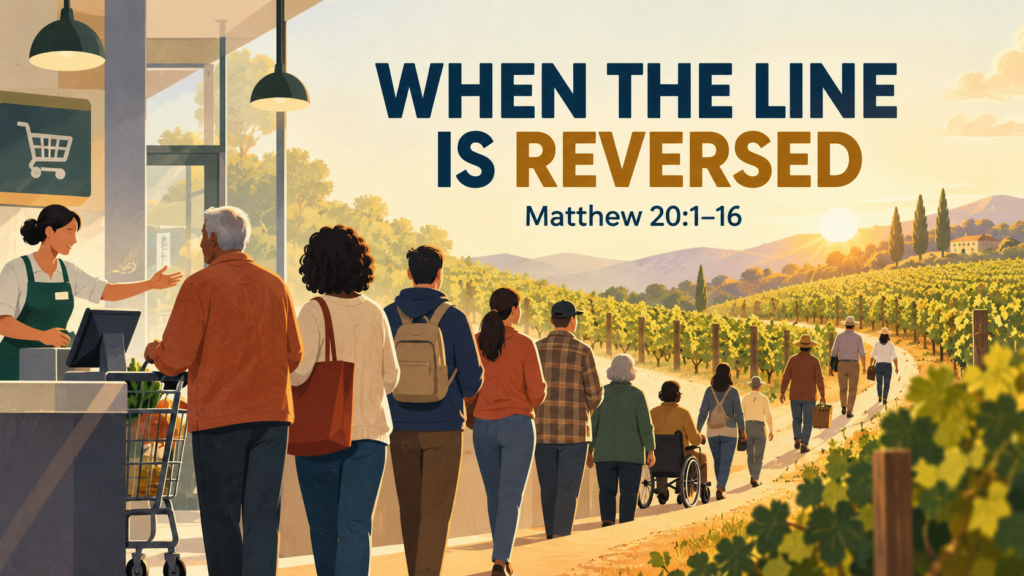

Sermon – When the Line is Reversed
Matthew 20: 1-16
Sermon preached by The Rev’d Tracey Gracey on Sunday 20 September, 2026
Have you ever found yourself in this situation? You have finished your shopping, moved to the checkout with the fewest people, and are patiently waiting in line. Other shoppers begin to gather behind you. Then a staff member opens the checkout next to you and calls the people at the back of your line across to be served!
I wonder if your reaction is like mine — irritation and grumpiness! That’s not fair. I was here first!
But why all the grumpiness?
When you stop and think about it, you have not actually lost anything — except, possibly, a little time. You still have your place in the line, and you are still going to be served.
What you have lost is the advantage you thought you had over the people behind you. Their gain begins to feel like your loss.
These feelings could well be similar to those experienced by the workers in today’s parable. At the end of the working day, the vineyard owner tells his manager: “Call the labourers and give them their pay, beginning with the last and then going to the first.”
That instruction matters. If those who began at sunrise had been paid first, they could have collected their denarius and gone home without knowing what anyone else received. Instead, the line is deliberately reversed: those hired last receive a full day’s wage while those who have worked since sunrise stand and watch. Their expectations rise.
But when their turn comes, they receive the denarius they had agreed upon. Nothing has been taken from them. They have received what was promised. But comparison has changed what that wage now means. The wage that seemed fair at sunrise feels unfair at sunset because someone who worked less is now treated as their equal.
This is known as mimetic rivalry.
The first workers no longer want only the wage they were promised. They want their payment to prove that they are worth more than those who arrived last.
The line has turned people who worked in the same vineyard into competitors.
Matthew is the only Gospel writer to include this parable, and where he places it matters. Immediately before the parable, Peter says to Jesus: “Look, we have left everything and followed you. What then will we have?”
Peter sounds very much like the workers at the back of the line: We have been here from the beginning. We have done the hard work and made sacrifices. What extra will we receive?
Jesus ends his response to Peter by saying: “Many who are first will be last, and the last will be first.” The parable that follows ends with the same reversal.
Peter’s question sets the scene for a parable that can be interpreted in two different ways.
The first interpretation does not assume that the landowner represents God.
The people who first heard this story knew what it was like to live in a world controlled by wealthy landowners. Day labourers had no secure employment. They gathered each morning and waited to be chosen. The owner decided who would return home with a wage and who would return with nothing. Those still waiting at five o’clock are not idle because they are unwilling. When asked why they have been standing there all day, they answer: “Because no one has hired us.” They have not refused to work: no one has chosen them.
This interpretation exposes an economic world in which some people control the opportunities available to others. It asks us to notice those who are excluded and then blamed for the situation they find themselves in.
The second interpretation looks at the landowner differently.
At the end of the day, he does something unexpected. He honours his agreement with those hired first but gives those hired last a full day’s wage. His generosity is not measured by the number of hours each person has worked or by how much they have produced.
This may reveal something about God. God does not calculate the worth of a human life by productivity, length of service, or position. Those who come last are not valued less than those who came first.
It is the response of the first workers to this generosity that the landowner confronts when he asks: “Are you envious because I am generous?”
The first workers receive what was agreed. The last receive unexpected generosity. They now stand beside one another as equals. The last do not become first by pushing the others to the back.
God’s kingdom does not reverse the line so that a different group can enjoy being more important; God’s kingdom challenges the belief that our worth depends upon standing ahead of someone else.
We are all workers within God’s vineyard — called at different times, bringing different abilities and experiences. Our place in the line is not always the same.
Some of us know what it is to be overlooked, left waiting or treated as though we have less to offer. To us, this parable offers reassurance: the place others give us does not determine our worth in the eyes of God.
At other times, we may find ourselves standing ahead of someone else. Then the parable asks us to notice who is being left waiting and to consider how we respond when they are given a place beside us.
Can we welcome another person as our equal without feeling that something has been taken from us? That is the challenge Jesus leaves with us.
At the end of the day, the first and the last stand together. The line that once separated them has lost its power.
Each is seen.
Each is called.
Each is given a place in the vineyard.
And each discovers that the generosity of God cannot be measured by comparison.
Amen.