
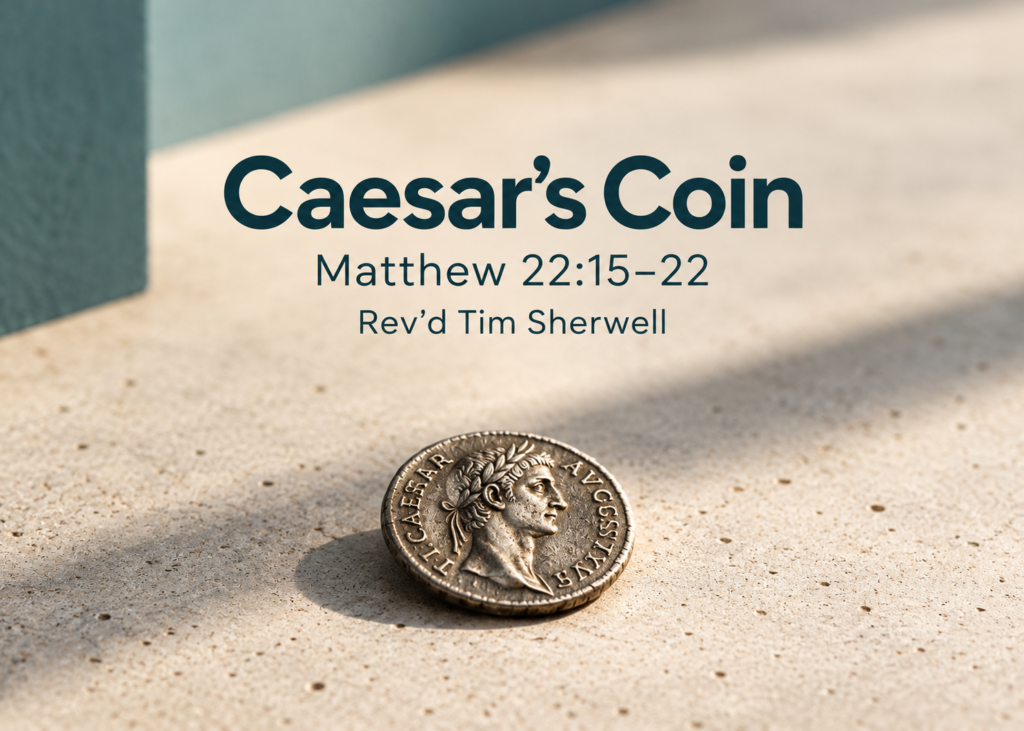

Matthew 22: 15-22 – Caesar’s Coin
Sermon by The Rev’d Tim Sherwell
Introduction:
Imagine finding yourself in a situation where no matter what you say, you lose. Total political entrapment. That is exactly what happens to Jesus in today’s Gospel.
Two groups — the Pharisees and the Herodians — come together to corner him. Now, you need to understand: these two groups usually hated each other. The Pharisees were fiercely loyal to Israel’s religious purity. The Herodians were loyal to King Herod and the Roman occupiers. They disagreed on almost everything. But they found common ground in wanting to get rid of Jesus. So, they throw a trap at his feet. They ask him: “Is it lawful to pay taxes to the emperor or not?”
It’s a perfect snare. If Jesus says “no,” he’s a traitor to Rome, and the Romans will arrest him for treason. If he says “yes,” he betrays Israel’s
religious purity, and the people will turn on him. He can’t win. It’s a lose-lose situation.
But Jesus is clever. He looks at a coin and says, “Give to the emperor what is the emperor’s, and to God what is God’s.” With one sentence, he steps right out of the trap. But for the early Christians reading Matthew’s gospel — and for us sitting here today — this story is about something much deeper than ancient taxes. It is a religious guideline for how we live in a complicated world, and how we make tough choices when the world tries to trap us.
Point 1: The Illusion of “What Feels Good”
So, how do we navigate this? First, we have to admit a hard truth: just because something feels good, doesn’t make it the right decision. From a
harmless little habit to a serious drug addiction — they all felt good the first time. Nobody on skid row ever intended to get there. Our addictions, our compulsions, our bad habits usually start because they take away our anxiety and discomfort. They make us feel whole in the beginning.
I understand why we desire relief. We want to feel better. But a quick fix is no substitute for the hard work of growing up — and growing into God. We have to be careful. The world is full of sweet things meant to entice us, but we have to look past the immediate comfort and look at the source.
Point 2: Giving the Church to Caesar
This same trap doesn’t just apply to us as individuals. It applies to institutions. It applies to our church. In our time, we know the church has
declined. And because of that decline, the church has become anxious and is suffering an overdose of managerialism. We talk about better leadership models, strategic plans, corporate business structures, Mission Action Plans, and vision statements.
These are all well-intended. Usually, we stamp them with a quick 30-second prayer. But unless we know how to listen to one another, unless we know how to accept one another, how to love, and how to live with compassion and justice… then we aren’t actually giving our church to God. We are at risk of giving it to Caesar. We are trying to run God’s house under the illusion that we can control it. Is it time, I wonder, for us to simply love one another and give the church back to God?
A wise Friar once said: “We cannot pray ‘Your Kingdom Come’ until we can first pray ‘My Kingdom Go.’” The invitation is to let go of a desire to control. In the practice of good religion, the organic stuff — community, compassion, and justice — always come before buildings, rituals, and tradition.
Point 3: The Freedom of Simplicity
So, how do we escape the trap? Perhaps the answer is simplicity.
Simplicity is a deeply religious concept. It frees us to live nearer to God because we stop trying to protect things we think belong to us. We stop
trying to guard our own kingdoms.
When you choose a life of simplicity, you neutralise the world’s grip. You take away other people’s ability to control you through fear, coercion,
expectations, authority. To be free from the world’s expectations is an opportunity to snuggle up a bit closer to God.
Simplicity is the very pathway that lets us give to God what is God’s. It takes us to the threshold of real joy.
Conclusion
We all have to live in this world. But as you go out into the week ahead, be aware of the traps. Be discerning when things feel a little too good to be true. Focus on community, compassion, and love. Living simply might not empower us in the eyes of the world, but it disarms the world’s ability to
control us. And that is where true freedom lies, it is in the freedom to be God’s people.