
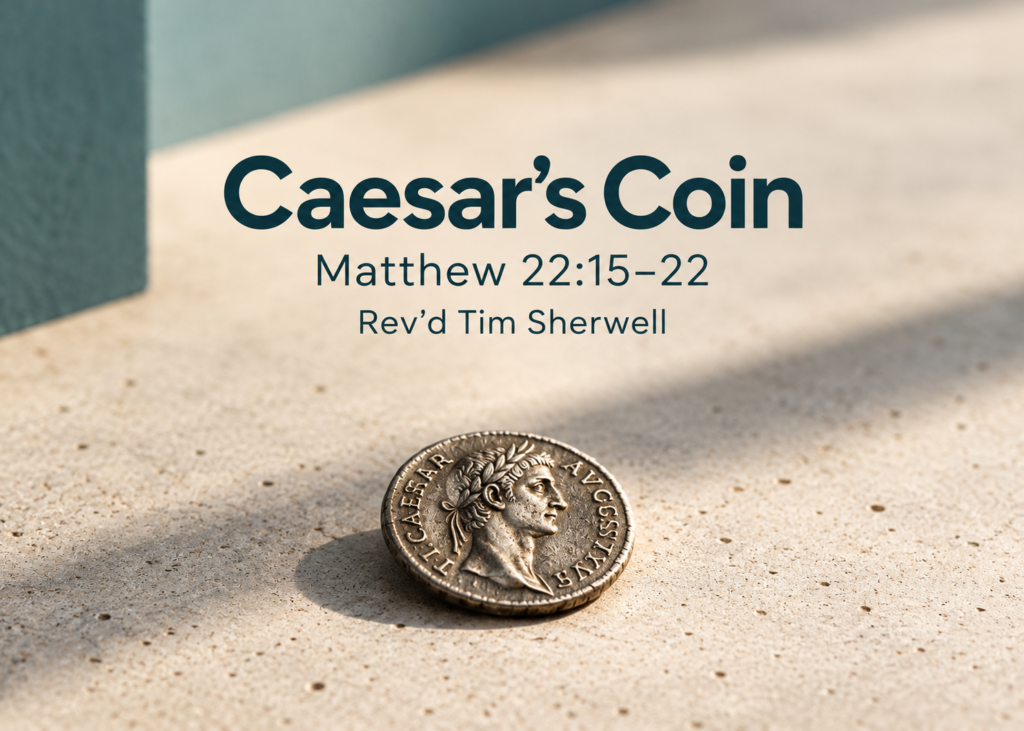

Matthew 22: 15-22 – Poll Tax
Sermon by The Rev’d Tim Sherwell
The poll tax is at the centre of today’s gospel reading. It was a tax of one silver denarius per annum imposed on adults over 18yo living in Roman
occupied territory. You could live on it for a month or two.
There are also two groups of men in this text. The Pharisees, and the Herodians, who form an unlikely alliance in order to rid themselves of a common pest – Jesus of Nazareth, who had landed at the Jerusalem Temple for Passover. Jesus has
stirred the crowds and threatened the authority and wealth of both groups. So it is a politically tense situation that Jesus finds himself in.
The Pharisees were faithful to the religious life of Israel, but were self important and attempted to govern with external authority. They were bearded men with nice tunics. They considered that paying the tax was a breach of the first two commandments.
The Herodians were faithful to King Herod and Greco-Roman rule, who gave them favours in return. They were clean shaven men, who curled their hair and wore gold tunics with vertical purple stripes. They supported the poll tax because it supported them.
The Pharisees and the Herodians formed an alliance to ask Jesus about the poll tax. Of course it is a trap. If he says “pay it” then he transgresses God’s law in the temple. If he says “don’t pay it” then he commits treason against the emperor. To everyone’s surprise, Jesus does the Albanese shuffle and steps sideways out of the loop.
What does that mean for us? In most cases, discernment is straight forward. We meet our civic responsibilities as honest citizens, and we honour God in our faith life. As adults we can work that out. However there may be times when we also feel trapped. God invites us to be free, but God also invites us to be responsible.
So here are a couple of ideas that may help:
1. Just because something feels good, doesn’t make it right. All addictions, compulsions and bad habits felt right the first time, they take away our anxiety and social awkwardness. Make us feel powerful. That is why we do it again. But sometimes these things can bring us undone too. That is more obvious in extreme things like addiction, but it is also true in chronic bad behaviours like being judgemental, critical or opinionated. Just because it feels good doesn’t mean we are doing the right thing by God / faith. Being right, but with a bad energy is not Godly.
2. The same trap can apply to the institutional church, which has experienced decline in recent years. Corporate anxiety has driven us into managerialism and strategic plans. That approach is saying “we need more people fast” and it says to leadership “sell a product that has little appeal,” which has broken far too many clergy and lay leaders. We rubber stamp these things with a quick prayer and say we’re giving it to God. But we’re not. That is just man trying to control God’s world. The truth is, we cannot pray: “Your kingdom come,” until we can first pray “my kingdom go.” I think our role is to practice the organic things like Community, Compassion, Justice. Actions guide the church.
3. Simplicity. If we decide to live simply, to be content with what we have, then we stop protecting things we think we own or control. Living simply neutralises the world’s grip on you. When you live simply you can love others, but you don’t need them as much, and you are more free to please God. We can then live in freedom and know joy. Simplicity is the pathway by which we give to God what is God’s.
In conclusion, we are aware that we live in this world and have civic responsibilities. Remember it can be wise to be discerning about ‘the things that feel good.’ Our job is to continue to live in community, to learn compassion, to learn to love and to learn to pray. Those who live simply will know the joy of it.
I end with a quote from Archbishop John Chrysostom of Constantinople 347-407: “if you do not find Christ in the beggar at the church door, then you will never find Him in the chalice.”