
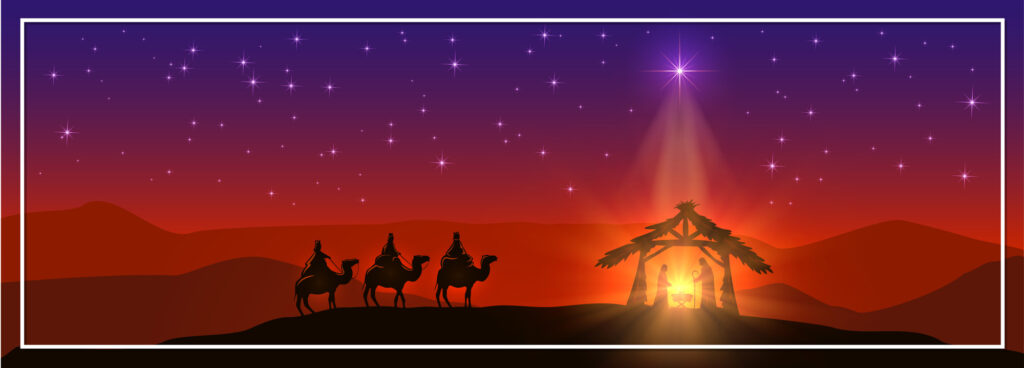

Christmas Sermon – The Un-Negotiable Gifts of Christmas
Sermon Preached by Reverend Tracey Gracey on Thursday, 25 December, 2025
I’d like to share with you one of my favourite Christmas jokes,
which is about a little boy who desperately wanted a new bike
for Christmas.
After constantly hounding his mother, she told him that the best idea would be to write a letter to Santa.
However, the boy had just played a major part in the school nativity play and thought it would be better to write to baby Jesus.
His first letter went,
“Dear Jesus, I have been a very good boy and would like a bike for Christmas.”
When he read it over, he wasn’t too happy, so he tried again.
“Dear Jesus, I’m a good boy most of the time, so I think I deserve a bike for Christmas.”
Still not right. So he tried a third version,
“Dear Jesus, I could be a good boy if I tried hard, especially if I was given a new bike for Christmas.”
That didn’t sit well either.
So he went for a walk to clear his head and think.
On his walk, he passed a house with a small statue of the Virgin Mary in the front garden.
Before he knew it, he had crept in, tucked the statue under his coat, hurried home, and hid it under the bed.
Then he wrote this letter,
“Dear Jesus,
if you want to see your mother again,
you’d better give me a new bike for Christmas!”
Christmas does not begin with a demand or a deal.
It begins with a gift,
not one we bargain for, but one that is given,
not a transaction, but a gift offered freely.
A Christmas gift is not earned.
Not deserved.
Not controlled.
Not expected.
And yet, when it is received, lives are transformed,
not because everything is understood,
but because hearts are opened.
If Mary had been bargaining with God,
the gifts she might have asked for could have been clarity,
support without suspicion, a future she could explain.
But Mary is not bargaining.
She is simply living her life,
and God meets her there.
What Mary receives is the gift of presence.
Not answers.
Not explanations.
But the quiet, steady assurance that God is with her.
Mary shows us that faith is not about having everything make sense.
It is about remaining open to the mystery of God even when the future feels uncertain.
She treasures and ponders, not because she understands,
but because something holy has taken place in her life,
and she chooses to receive the gift she has been given.
If Joseph had been negotiating with God,
the gifts he might have asked for could have been proof,
a plan that protected his name, a decision that asked less of him.
But Joseph is not negotiating.
He is trying to do the right thing,
and God meets him there.
What Joseph receives is the gift of courage.
Not control.
Not guarantees.
But the strength to trust and to stay.
Joseph shows us that faith is not about having all the answers.
It is about choosing faithfulness when the way forward is unclear.
He acts, not because everything makes sense,
but because he willingly receives the gift that has been
entrusted to him.
If the shepherds had been bargaining with God,
the gifts they might have asked for could have been respect,
fair pay and recognition.
But the shepherds are not bargaining.
They are simply doing their job,
keeping watch, getting through the night.
What they receive is the gift of being seen.
Not because they asked for it.
Not because they earned it.
But because God chooses them.
And with that gift comes an invitation.
The angels do not give them instructions to improve themselves,
or demands to prove their worth.
They give them good news,
and then send them to receive it.
The gift is not only the message,
but the invitation to go and see.
The shepherds, after viewing the baby, return changed,
not because their circumstances improve,
but because they now know they are noticed, named, and included.
This is the gift they graciously receive.
If the wise men had been bargaining with God,
the gifts they might have expected
could have been certainty, confirmation that their learning,
their watching, and their long journey had been correct.
They arrive prepared.
Educated.
Resourced.
Ready to offer something of value.
But God does not reward them with answers.
Instead, God unsettles them.
What they receive is the gift of disruption.
They come searching for a king and find a child.
They come with gifts to give
and discover they are the ones who must kneel.
They leave without certainty,
their lives re-oriented,
receiving the gift they have been given,
returning home and living differently
because of what they have encountered.
Presence, courage, being seen, and disruption.
These are the unnegotiated gifts of Christmas.
But there is one more gift we don’t have to bargain for,
one that, like Mary, Joseph, the shepherds, and the wise men,
we are simply invited to receive – the gift of nourishment.
At his birth, Jesus is placed in a manger,
not in a crib,
not on a throne,
but in a feeding trough.
From the very beginning, God chooses to be found
in a place where hunger is met.
And Jesus is placed here as our spiritual nourishment for the journey,
for the faithful, for tired hearts, for uncertain lives,
for a world yearning for peace.
In recent weeks, we have been reminded
how fragile our most relaxed, playful, and enjoyable places can be.
How quickly celebrations and freedom can be shattered.
How close grief can come.
The unnegotiable gift of Christmas does not turn away from this reality. The gift of Christmas enters it.
With presence that steadies us,
With courage that carries us,
With eyes that see us,
With disruption that opens new paths,
and with nourishment that sustains us.
The gift of Christmas reminds us that God does not always give us what we expect or desire, but rather what transforms us.
This gift is non-negotiable.
It is not earned.
It is not withheld until we are ready.
But like Mary, Joseph, the shepherds, and the wise men,
it can be graciously received and lived.
Dear Jesus,
I don’t really want a bike for Christmas.
What I would like is the gift of Christmas,
your presence to steady me,
your courage to carry me,
your eyes to see me,
your disruption to move me,
and your nourishment to sustain me.
Amen.