
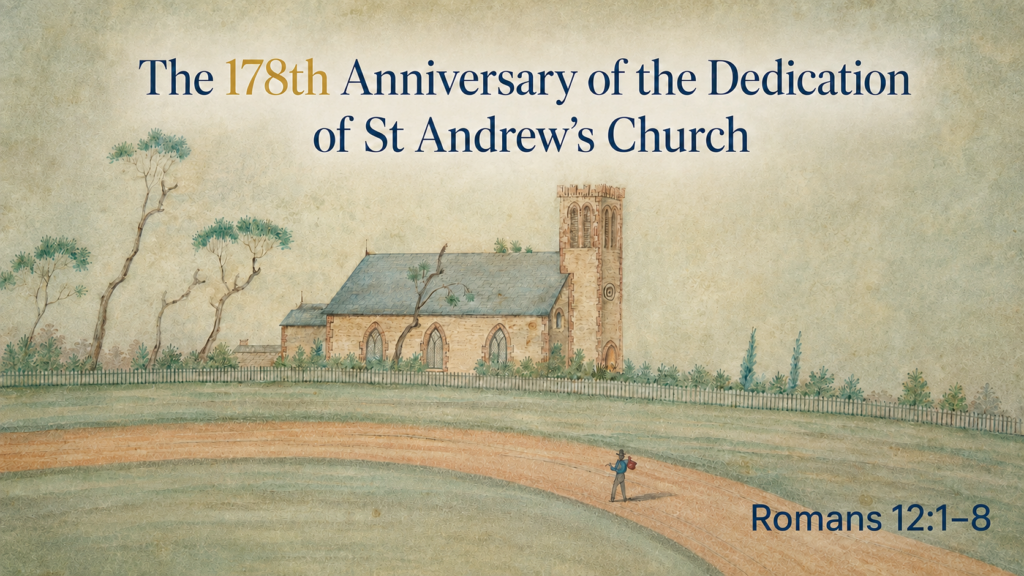

Sermon – A Living Dedication
Romans 12:1–8
Sermon Preached by The Rev’d Tracey Gracey on Sunday 23 August, 2026
Imagine this.
You are at a luncheon with friends and family, and someone has made a beautiful pavlova.
It has been carefully decorated with cream and fruit and is being carried into the room when suddenly, the person stumbles and the pavlova ends up all over the floor.
What would be your first response?
- Would you find a cloth and begin cleaning up?
- Would you offer to buy or make another dessert?
- Would you work out why the tray tipped and how to prevent it happening again?
- Would you check that the person was all right and comfort them?
- Would you say, “Don’t worry—we can sort this out”?
- Would you take charge: “You find a mop; you clear the floor; I’ll arrange another dessert”?
- Would you point out what needs to change: “We need to be more careful when carrying the food”?
[Ask people to now raise their hand when you reach the response they would make first.]
Who would begin cleaning?
Who would replace the dessert?
Who would work out what had gone wrong?
Who would check that the person was all right?
Who would reassure everyone?
Who would take charge?
And who would point out what needed to change?
This incident is often used to illustrate the different spiritual gifts that Paul describes in today’s reading.
The person who begins cleaning is linked with ministry or service.
The person who offers to replace the dessert is linked with generosity.
The person who works out why it happened is linked with teaching.
The person who comforts the embarrassed person is linked with compassion.
The person who says, “Don’t worry—we can sort this out,” is linked with encouragement.
The person who begins organising everyone is linked with leadership.
And the person who points out what needs to change is linked with prophecy.
The responses are deliberately exaggerated. They do not place us into fixed categories, but they make the point.
We do not all have the same gifts and we respond differently because we notice different needs.
In our reading from Romans this morning, Paul does not begin by talking about our gifts.
He begins with God “I appeal to you, therefore, brothers and sisters, by the mercies of God.”
Everything that follows begins with God’s loving compassion towards us.
We do not serve God to earn God’s love.
We do not use our gifts to prove that we are more faithful or more important than someone else.
Our service is our response to God’s love—freely given, not earned.
Paul invites us to offer our living selves to God:
Our bodies, minds, time and abilities.
Our possessions, decisions and relationships.
Our whole lives.
This does not mean letting others control or use us. Nor does it mean working until we have nothing left to give.
It means making our lives available to God.
Paul describes this offering of our lives as worship.
Worship is not limited to what happens inside a church building on Sunday morning.
It continues in the way we live and how we use our gifts for one another.
This morning we are celebrating the 178th anniversary of the dedication of St Andrew’s Church.
To dedicate something is to set it apart for God.
One hundred and seventy-eight years ago, this building was dedicated as a place of worship, prayer and Christian community.
But the dedication of St Andrew’s has never been just about the building.
It has been lived out through generations of people who have offered themselves to God.
When we look back across the history of St Andrew’s, we can see these gifts in:
The people who saw what was needed and were willing to name it.
The people who rolled up their sleeves and did the work.
The people who taught the faith and helped others understand it.
The people who encouraged the parish to keep going during difficult times.
The people who gave generously.
The people who provided leadership and brought others together.
The people who quietly offered compassion to those who were hurting.
Some of their names have been recorded.
Many have not.
But we are here today because they offered their lives and gifts to God.
All of this reminds us that the story of St Andrew’s is not simply the story of a building.
It is the story of people.
People who noticed a need and responded.
And now this story continues through us.
Paul says that we are “members one of another”.
We do not merely attend the same church.
We belong to one another.
Paul tells us not to think more highly of ourselves than we ought.
But we can also make the mistake of believing that our contribution is too small to matter.
Acknowledging and using our gifts is recognising and claiming them as gifts from God. They do not make us more important than anyone else, and no one person has every gift the Church needs.
We need the gifts of others.
Our gifts are most useful when they are offered together.
Paul also speaks about being transformed by the renewing of our minds so that we can discern God’s will.
Discernment means listening together for where God may be leading us.
As one body, we each bring different experiences, questions and gifts to that listening.
This is the purpose of the Missional Discernment Pathways sessions that we will soon begin at St Andrew’s.
They are an opportunity to come together and listen for what God may be asking of us in the next part of our journey together.
We need the memories and wisdom of those who have been part of St Andrew’s for many years.
We need the questions and insights of those who have joined us more recently.
We need teachers, encouragers, practical helpers, generous givers, careful leaders and compassionate hearts.
Each person brings part of our story and part of the wisdom we need as we consider the future.
Today we give thanks for 178 years of worship, service and faith.
We remember those who offered their lives and gifts before us.
But an anniversary is not only an opportunity to look backwards.
It is also an opportunity to ask what God may be calling us to now.
The story of St Andrew’s is not finished.
Now it is our turn – to be a living dedication – to listen, to discern and to offer our gifts.
Amen.