

Easter Day
Sermon Preached by Reverend Tracey Gracey on Sunday, 5 April 2026
The resurrection story is told by four different communities.
Matthew, Mark, Luke, and John, and each community, tell their story in their own way.
Mark is brief and unresolved.
Luke takes us on a journey from confusion to recognition.
John is intimate and personal.
But Matthew… is dramatic.
There is an earthquake.
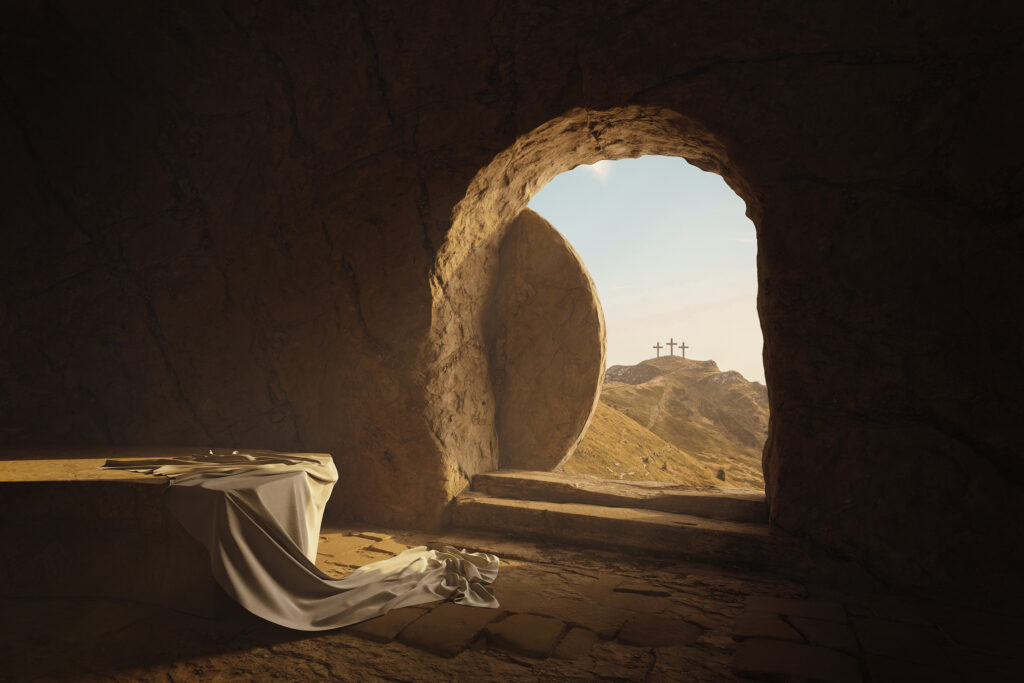
An angel descends and rolls back the stone.
The guards shake with fear and fall to the ground.
It’s vivid.
It’s unsettling.
It’s surreal.
And yet — even here — no one actually sees Jesus rise.
We are told everything around the event of Jesus’ resurrection,
but not the moment itself.
Which may suggest that resurrection is not something we watch happen but something we come to recognise and experience.
Maybe we are not meant to find proof or to pin down exactly what happened.
Maybe we are being invited to pay attention to how resurrection is revealed in the lives of those who encountered it.
So that we might begin to discover how
Mystery,
Presence,
Restoration,
Transformation,
and being sent shape what it means to live as resurrection people.
So we begin with mystery…
Barbara Brown Taylor reminds us that no one was there to witness what happened inside the tomb.
Whatever took place happened beyond human sight.
But that doesn’t make it unreal.
It remains a mystery, yet a mystery that is known differently,
through encounter, through trust, through what it does in people’s lives.
And in Matthew’s Gospel, that’s exactly what we see.
The women do not see Jesus being resurrected.
They stand at the edge of mystery and are drawn into it.
They experience its impact.
They are afraid and yet they go.
They don’t understand and yet they leave to tell the others.
And perhaps that is how the resurrection is first known,
not by explanation, but by being drawn into the mystery itself and letting it empower us.
And that leads us into PRESENCE…
Rowan Williams suggests that the risen Jesus is not cut off from ordinary life but continues to be known within it.
Not as a distant figure but as a presence.
Which means resurrection is not about Jesus disappearing,
but about learning to recognise him differently.
In Matthew, Jesus meets the women and the disciples.
He speaks to them. He sends them.
The same Jesus they followed is still with them.
And that matters.
Because resurrection is about discovering that Christ is still present within our world.
in the moments of care,
in acts of kindness,
in conversations that bring life,
in the ways we show love to one another.
From presence, we begin to see RESTORATION…
René Girard, helps us see the cross and resurrection through the patterns of human behaviour. He reminds us that when things go wrong, we often seek to restore order by placing the blame on someone else.
In the crucifixion of Jesus, this pattern is revealed.
He becomes the one who is blamed, the victim, an innocent one whom God raises.
And this is where everything shifts.
The cross shows us what we do, what humanity does.
The resurrection shows us what God does.
Because in raising Jesus,
God does not confirm the crowd’s judgment or actions,
God overturns them.
God stands not with the rejection,
but with the one who was rejected.
And more than that, God does not respond with blame in return.
God responds with forgiveness.
Not by denying what has happened,
but by refusing to let it have the final word.
And in raising Jesus, God exposes what has really happened.
The one we rejected was never the problem.
For community is not rebuilt by pushing someone out but by being drawn back together.
Not through blame — but through forgiveness.
And that is what resurrection makes possible:
a community where people can return,
be restored, and begin again together
a community shaped by forgiveness.
Restoration leads us into TRANSFORMATION…
Hans Urs von Balthasar reminds us that resurrection is not about escaping pain, but about transformation within it.
For God does not stand outside suffering,
but enters into it.
In Jesus, we see a God who does not remain distant from human pain, but shares in it.
God does not erase what has happened to Jesus.
The wounds, the failure, the grief — they are real.
What happened on the cross matters.
But it is not the end of the story.
Instead, God takes what feels like the end
and begins to bring life out of it.
And perhaps this is what is most striking about the resurrection,
not that suffering is avoided, but that it can be transformed.
That even in the places of loss and pain,
God is present and still at work.
And we know this, not just in theory, but in our lives.
When meaning begins to emerge where once there was only loss.
Resurrection is not starting again from nothing,
it is being made new from what already is.
And finally, resurrection leads to BEING SENT…
N. T. Wright says that the resurrection of Jesus is the beginning of God’s new project, the renewal of the world.
And in Matthew’s Gospel, that project begins with a simple statement and one word
“Do not be afraid.”
“Go.”
The disciples are not just comforted, they are commissioned.
They are sent to live differently, to share and to live out what they have seen and experienced in Jesus.
And that same invitation is given to us.
Resurrection is not something to keep to ourselves.
It is something that moves us outward.
Into how we live.
Into how we treat one another.
Into how we respond to fear, to pain, to uncertainty.
To live as resurrection people
is to carry hope where there is fear,
to carry compassion where there is hurt,
and to trust that new life is always possible,
even when we cannot yet see it.
So perhaps this Easter, the invitation is not to explain everything but to notice.
Where life is beginning again.
Where hope is returning.
Where love is calling us forward.
Because resurrection is not just something that happened.
It is something we are invited to recognise, to receive, and to live.
So, do not be afraid.
Go and be people of the resurrection.
Amen.