
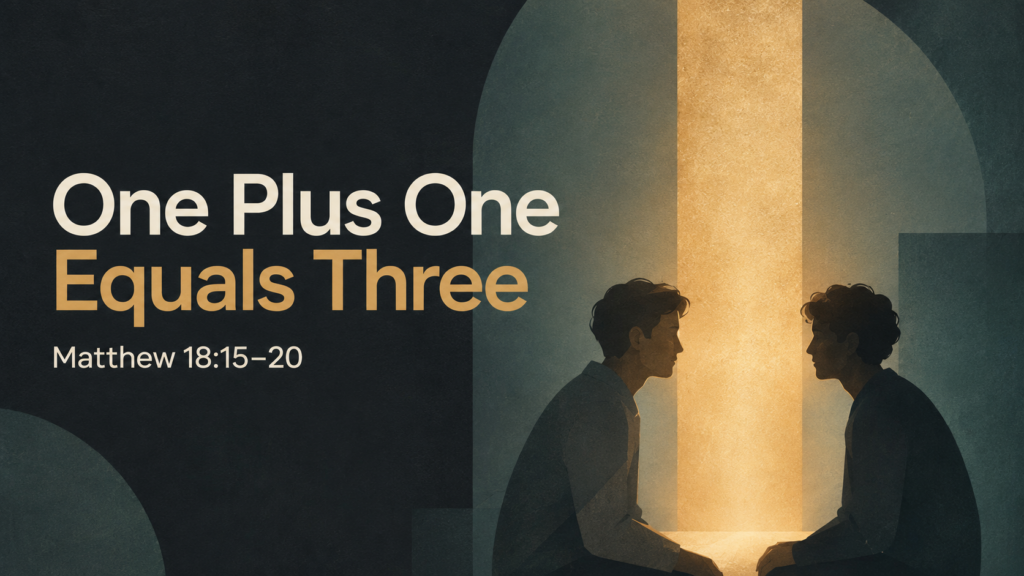

Sermon – One Plus One Equals Three
Matthew 18: 15-20
Sermon preached by The Rev’d Tracey Gracey on Sunday 6 September, 2026
Can one plus one equal three?
According to Jesus, it can.
If two people are gathered in Jesus’ name and Jesus is present among them, then in Christian mathematics, one plus one can equal three.
This unusual equation comes at the end of Jesus’ teaching about conflict, wrongdoing and reconciliation within a community.
Jesus reminds us that when two people attempt to face a difficult truth in his name and in his way, they are not alone. Christ is present in the difficult space between them.
But what happens when a relationship has been torn apart by fear, violence and betrayal? How can people begin to heal the rift?
That was the question I found myself asking in 2006, when I led a diocesan youth pilgrimage to Rwanda with then-Archbishop Jeffrey Driver.
While we were in Kigali, the capital of Rwanda, we visited the Genocide Memorial, established in memory of those killed in the 1994 Genocide against the Tutsi.
Over a period of approximately 100 days, around one million people were killed. About 250,000 are buried at the Kigali Memorial.
When we visited in 2006, there were mass graves outside, with one burial area still open because human remains were still being found.
The most confronting part for me was the children’s exhibition. Large photographs were accompanied by each child’s name, favourite food, favourite toy and what they enjoyed doing. Then came the brief and brutal account of how each child had died.
What was difficult to comprehend was not only the enormous number of people killed, but the knowledge that neighbours had turned against neighbours.
How could justice be sought when so many people were accused of participating in the killings, and how could forgiveness and reconciliation ever begin?
We learnt that Rwanda developed community-based courts known as gacaca — often described as “justice on the grass”. People gave testimony within their communities, while those who confessed and accepted responsibility could receive reduced sentences or community service.
The process attempted to hold people accountable while making eventual reintegration possible. It was imperfect, and no court could command forgiveness or remove the grief. Yet it created a place where truth could be heard and communities could begin the long work of living together again.
Reconciliation began, not with forgetting, but by remembering truthfully, establishing responsibility and seeking a way to live together differently.
These three movements also run through our readings this morning.
In Exodus, the Passover meal is given to Israel as an act of remembrance.
The people are to remember their slavery. They are to remember the empire that treated them as though their lives did not matter. They are to remember the God who heard their cries and led them towards freedom.
This remembrance was not simply about preserving the past. It was intended to shape the kind of community they became.
In his letter to the Romans, Paul reminds us that authority and law have a part to play in maintaining a community. Authority is meant to serve the common good, restrain wrongdoing and establish accountability.
But Paul does not finish with authority, law or punishment. He finishes with love, because it is love that can begin to restore a relationship.
This does not mean ignoring wrongdoing or simply being nice. The love Paul describes tells the truth, protects the vulnerable, accepts responsibility and refuses vengeance.
In the Gospel of Matthew, Jesus gives his followers a way of putting that love into practice.
If another member of the community has caused harm, go and speak with them directly.
If the difficulty cannot be resolved, take one or two others who can listen and help establish what has happened.
Only then is the wider community brought into the situation.
René Girard helps us understand why Jesus instructs us to speak directly to the person concerned.
When we are hurt or angry, we often turn first to someone who will reassure us that we are right. We draw others in, sides form, and one person may be made to carry responsibility for everything that is wrong.
Girard calls this the scapegoat process: a group finds unity by agreeing about whom to blame.
In this kind of human mathematics, one plus one also equals three—but the third person has been recruited as an ally against someone else.
Jesus offers us a different equation. When two people gather in his name, Christ is the third presence—not an ally recruited to prove that we are right, but the one who calls us towards truth, responsibility and mercy.
The witnesses are not supporters gathered to strengthen our side. They are there to help everyone see the situation more clearly.
The aim is to restore the relationship.
That does not mean every relationship can be restored to what it was. Forgiveness does not mean pretending that the harm was unimportant. Reconciliation does not require someone to return to an unsafe situation.
We may never face anything comparable with what the people of Rwanda faced. But the same patterns of human behaviour can appear in our families, friendships, workplaces, churches and communities.
When someone hurts us, do we speak to them or about them?
Do we look for people who will help us understand, or people who will simply agree with us?
Are we seeking healing and accountability, or are we seeking victory?
Christian reconciliation is not forgetting, excusing or concealing what happened.
It is remembering truthfully.
It is establishing responsibility.
It is refusing to create another victim.
And it is allowing the love of Christ to lead us towards another way of living together.
One plus one can equal three.
When two people gather in the name and way of Jesus, Christ is present in their midst.
Amen.