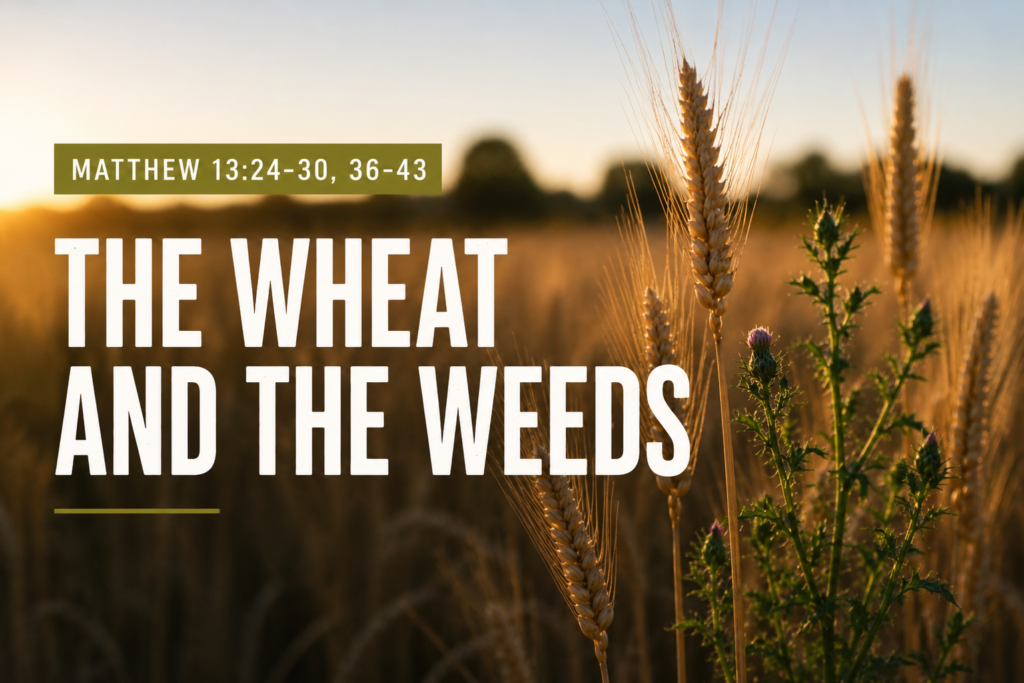

Sermon – The Wheat and the Weeds
Matthew 13:24–30, 36–43
Sermon Preached by The Rev’d Tracey Gracey on Sunday 19 July, 2026
If Jesus had a favourite way of teaching, it was through parables.
In fact, around one-third of everything Jesus taught in Matthew, Mark and Luke was told through parables.
The telling of parables was a common form of storytelling in the ancient world.
Jesus, however, used parables more than anyone else.
What made Jesus’ storytelling different was the way he used ordinary stories and familiar images to help people glimpse what the Kingdom of Heaven is like.
The Gospels record around forty parables.
Matthew records more than twenty of them, which is more than any of the other Gospel writers.
About half of Matthew’s parables are also found in Mark or Luke, while the other half are unique to Matthew.
Today’s parable, The Wheat and the Weeds, is one of those unique parables.
Last Sunday, we began our journey through Matthew chapter 13, a chapter that brings together seven parables about the Kingdom of Heaven.
Last week we heard The Parable of the Sower.
Today, we hear The Wheat and the Weeds.
Next Sunday, we will hear The Hidden Treasure, The Pearl of Great Price and The Net.
Together, these parables paint a picture of what the Kingdom of Heaven is like.
The Kingdom begins like a tiny seed.
It grows quietly like yeast through dough.
It is worth everything, like treasure hidden in a field.
Parables aren’t simply nice stories with a moral at the end.
A parable usually makes one central point.
It begins with something ordinary and familiar.
A farmer sowing seed, yeast mixed through dough, a fishing net or a pearl.
These everyday images are then used to reveal something deeper about God, ourselves and the Kingdom of Heaven.
Parables move us from the known to the unknown; from something familiar to something hidden.
They don’t give us all the answers.
Instead, they invite us to think again.
They challenge our assumptions.
They turn our expectations upside down.
And very often they surprise us.
Today’s parable is full of surprises.
The first surprise is the farmer.
The servants discover weeds growing among the wheat and immediately ask, “Do you want us to go and pull them up?”
It seems like a sensible question.
It’s practical. It’s efficient. It shows initiative.
It is probably the question most of us would ask.
Yet the farmer simply says, no, leave them.
That response turns the story upside down.
Our natural instinct is to act quickly.
Remove the problem.
Fix the situation.
Sort everything out.
But the farmer refuses to rush.
He is calm, patient and unhurried.
He is not anxious about the field because he knows something the servants do not.
The farmer reveals something important about the Kingdom of Heaven.
God is not anxious. God does not panic. God is never caught by surprise.
God is already at work, even when we cannot see the outcome.
The second surprise is the servants.
They are not bad people.
They are not lazy.
They are not malicious.
They genuinely want to help.
Yet they assume they already know what should happen.
They think they have seen enough.
They think they know exactly what the farmer should do.
That is where this parable begins to challenge us.
How often are we convinced we know the whole picture?
How often do we make quick judgments?
How often do we decide what should happen before we have taken time to look more carefully?
Parables rarely offer certainty.
Instead, they invite us to slow down.
To look more carefully.
To listen more deeply.
To allow our relationship with God to reshape the way we see our circumstances.
The third surprise is the field.
It isn’t a perfect field.
There are weeds.
Yet the wheat continues to grow.
That is Jesus’ picture of the Kingdom of Heaven.
God’s Kingdom does not wait until everything is perfect before it begins its work.
It is already growing.
Quietly. Patiently. Steadily.
In the middle of ordinary life.
When we look at the field, our attention is often drawn to what is wrong.
The farmer’s attention is fixed on what is growing.
His focus is on the harvest.
That becomes the invitation of this parable.
Not to ignore the weeds.
Not to pretend they are not there.
But not to allow them to become the whole story.
The Kingdom of Heaven is already at work.
Growing quietly. Growing patiently.
Growing even when we don’t notice it.
Often in ways we cannot yet see.
As we continue exploring Matthew’s parables, don’t rush past them.
Sit with them.
Listen to them.
Allow them to challenge you.
Allow them to surprise you.
Above all, allow them to help you catch a glimpse of the Kingdom of Heaven – to see God differently, to see yourselves differently, and to recognise the Kingdom of Heaven at work in the ordinary moments of your life.
May you have eyes to notice, ears to listen and hearts that remain open to the surprises of God’s Kingdom.
Amen.